What civil-procedure changes did Act 127 enact, and how did the abandonment provisions enter the final law?
Finding
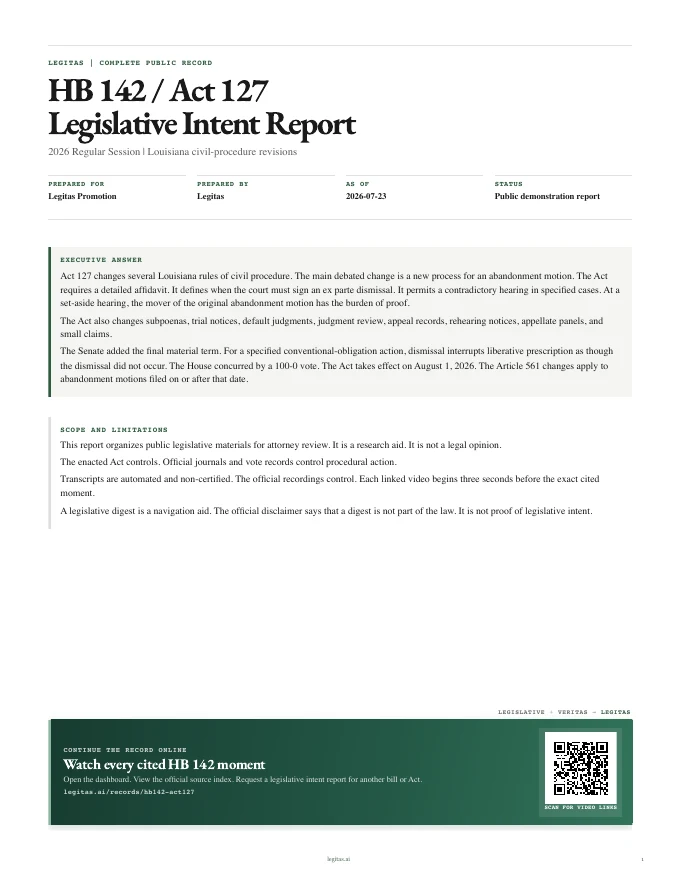
Act 127 requires a detailed abandonment affidavit, defines the court's procedural options, and keeps the burden with the mover of the original abandonment motion at a hearing to set aside an ex parte dismissal.
Limit: The enacted text controls. Proceedings document the legislative path but do not, by themselves, prove any participant's private motive.
A new abandonment process—and a practical civil-procedure checklist.
Act 127 requires a detailed abandonment affidavit, defines the court's procedural options, and keeps the burden with the mover of the original abandonment motion at a hearing to set aside an ex parte dismissal.
Effective dateAugust 1, 2026.
Prospective ruleAmended Article 561 applies to motions filed on or after the effective date.
Final material additionArticle 561(L) addresses prescription after abandonment of a conventional-obligation action.
How the final law took shape
The final Act developed through three adopted amendment stages.
01
Original bill
Continuous revisions proposed
The opening text updated several procedural articles. House committee work added the detailed appeal-record and Article 561 mechanics.
02
House committee and floor
Affidavit and appeal steps refined
Amendments 2069 and 2289 produced the reengrossed instrument sent to the Senate.
Use the enacted text for the rule. Use the proceedings to understand the path.
The record shows why the proposal focused on affidavit detail, judicial review, appeal-record cost, and more predictable procedure. It also shows how the final prescription provision entered the Act.
It does not convert testimony into a legislative fact or prove the private motive of any legislator.
Your law. Its complete record.
Commission Legislative Intent.
Send the bill, Act, ordinance, or legal question. Legitas will define the record, locate the controlling sources, and return a source-linked research packet for attorney review.
Research notice. This public record organizes legislative materials for attorney review. It is not a legal opinion. Transcripts are automated and non-certified; the official recordings control. A legislative digest is a navigation aid and is not part of the law.