When did the express abolition and transfer mechanism enter SB 256, and what did Act 15 ultimately enact?
Finding
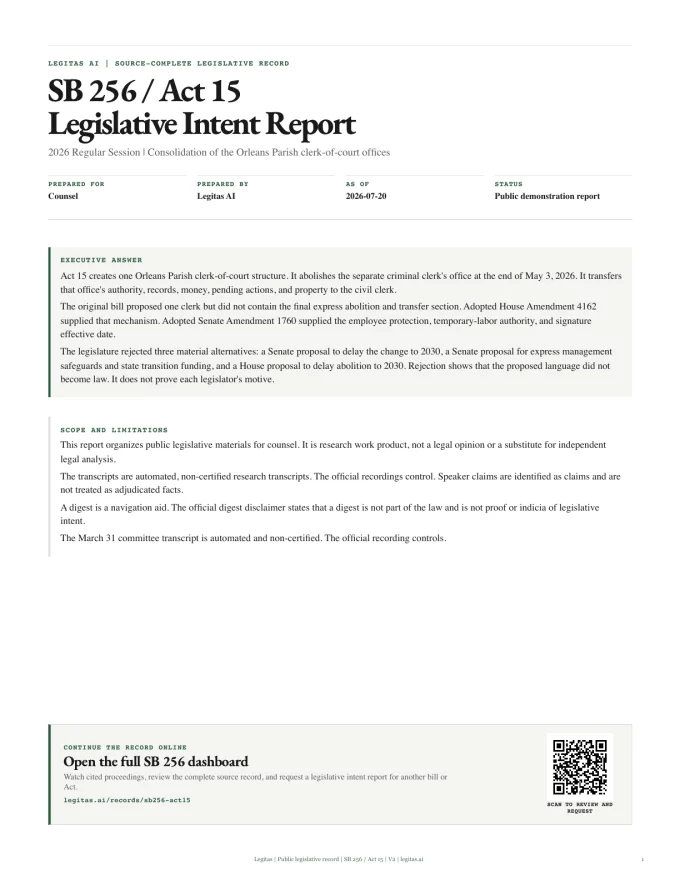
Act 15 abolishes the separate criminal clerk's office after May 3, 2026, and transfers its authority, records, money, pending actions, and property to the civil clerk. The express mechanism entered through adopted House Amendment 4162—not the original bill.
Limit: The official record establishes the text and legislative path. It does not, by itself, prove any participant's private motive.
One office. An express transfer. Several transition clocks.
Act 15 abolishes the separate criminal clerk's office at the end of May 3, 2026. Its authority, records, money, pending actions, and property transfer to the civil clerk.
EmployeesProtected through January 15, 2027, except for good cause.
Transition capacityTemporary employees or contractors authorized through June 30, 2027.
Effective dateThe Act took effect when signed on April 30, 2026.
How the final law took shape
The enacted mechanism arrived through amendment—not in the original bill.
01
Original bill
One clerk proposed
The opening text proposed a unified office but did not contain the final express abolition and transfer section.
02
Adopted House Amendment 4162
Abolition and transfer added
The House supplied the end-of-May-3 date, the broad transfer, reference redirection, and statutory repeals.
Use the enacted text for the rule. Use the proceedings to understand the path.
The record shows why sponsors advanced consolidation, where lawmakers identified transition problems, which alternatives were rejected, and how the final transfer language entered the Act.
It does not convert testimony into a legislative fact or prove the private motive of any legislator.
Your law. Its complete record.
Commission Legislative Intent.
Send the bill, Act, ordinance, or legal question. Legitas will define the record, locate the controlling sources, and return a source-linked research packet for attorney review.
Research notice. This public record organizes legislative materials for attorney review. It is not a legal opinion. Transcripts are automated and non-certified; the official recordings control. A legislative digest is a navigation aid and is not part of the law.